
By Dr. SK Gupta, MD,CFM (France),Sr Consultant Physician Hospital, New Delhi.
“Incorporating HMPV into routine respiratory virus surveillance systems is essential to better understand its burden and to guide public health interventions.” – From a commentary in The Lancet Infectious Disease
Transmission of Human Metapneumovirus (HmPV)
HMPV primarily spreads through:
1. Secretions from coughing and sneezing.
2. Close personal contact (e.g., touching or shaking hands).
3. Touching contaminated objects and then touching the mouth, nose, or eyes.
Can it spread from Hospitals?
- Hospital-acquired HMPV infection spreads have been documented, emphasizing the critical need for strict hygiene practices among healthcare workers to prevent outbreaks.
Is there a Vaccine for HMPV
- Vaccine research for HMPV is underway. An mRNA-based combination vaccine for HMPV and parainfluenza virus 3 (PIV3), known as mRNA-1653, has shown promising results in Phase 1 trials involving healthy adults aged 18–49 years.
Recent Surge in Cases in China
- Data from the Chinese Centre for Disease Control and Prevention (China CDC) revealed a significant increase in respiratory infections from December 16 to 22, 2024. During this period, HMPV was linked to:
- 6.2% of positive respiratory illness tests.
- 5.4% of respiratory-illness-related hospitalizations, surpassing COVID-19, rhinovirus, and adenovirus.
Previous Outbreaks of HMPV
- It has been implicated in significant outbreaks in the past:
- It accounted for 12% of acute respiratory tract illness cases in otherwise healthy children in U.S. outpatient clinics.
- It caused 15% and 8% of community-acquired pneumonia requiring hospitalization in children under and over 5 years of age, respectively, in the United States.
- As of 2016, it was the second most common cause of acute respiratory tract illness in children under 5 years of age in U.S. outpatient clinics, after respiratory syncytial virus (RSV).
- The current incidence of nearly 6% in the Chinese study, while notable, aligns with historical data and may not warrant significant concern.
Global Spread Potential.
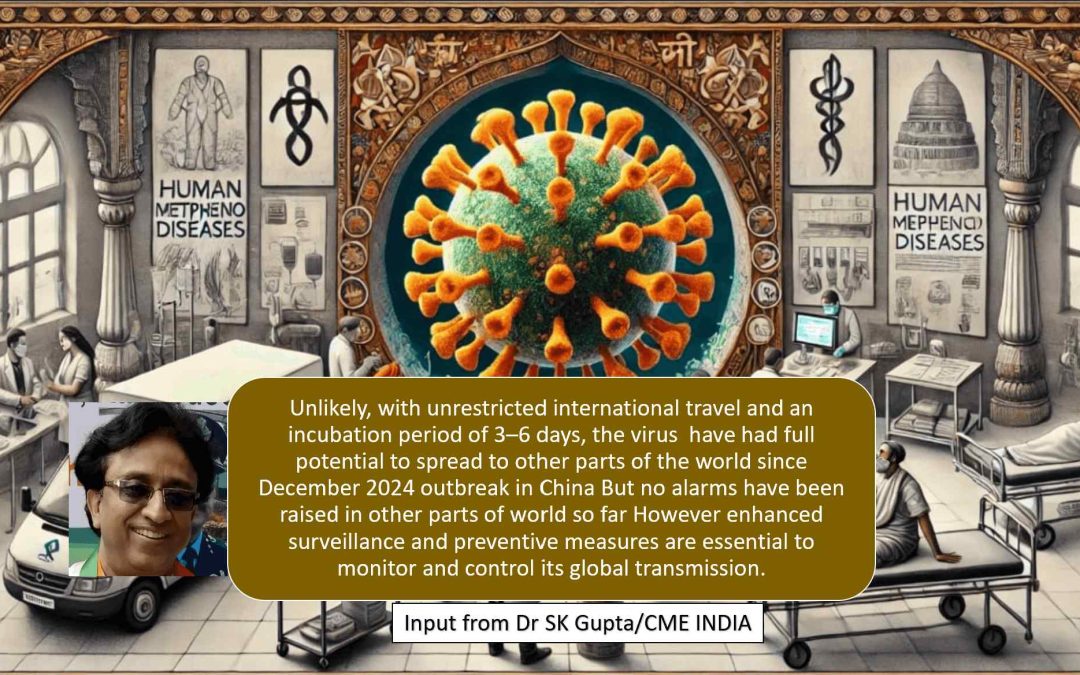
- Unlikely, with unrestricted international travel and an incubation period of 3–6 days, the virus has had full potential to spread to other parts of the world since December 2024 outbreak in China But no alarms have been raised in other parts of world so far However enhanced surveillance and preventive measures are essential to monitor and control its global transmission.
Just a Seasonal Circulation
- HMPV typically circulates during the fall and winter months, with alternating predominance of a single subtype each year.
CME INDIA Tail-Piece
- Human Metapneumovirus (HMPV) was first identified in 2001 by Dutch researchers who discovered the virus in children with respiratory tract infections. Discovery (2001): HMPV was first isolated from nasopharyngeal aspirates of children in the Netherlands who had symptoms similar to those caused by respiratory syncytial virus (RSV) but tested negative for known respiratory viruses.
- Genetic Classification: Following its discovery, HMPV was classified under the family Paramyxoviridae, genus Metapneumovirus. It shares significant genetic similarity with avian pneumovirus, suggesting a common ancestor.
- Global Prevalence: Soon after its identification, serological studies revealed that HMPV infections were not new but had been occurring worldwide for a long time. Antibodies to HMPV were found in humans from samples dating back to the 1950s, indicating that the virus has been circulating for at least half a century before its formal identification.
- Clinical Impact: HMPV is now recognized as one of the leading causes of acute respiratory tract infections, particularly in young children, the elderly, and immunocompromised individuals. It’s responsible for a spectrum of illnesses from mild upper respiratory infections to severe lower respiratory tract infections like bronchiolitis and pneumonia.
- Seasonality: Like other respiratory viruses, HMPV infections show seasonal patterns, predominantly occurring in winter and spring in temperate climates, although it can circulate year-round in tropical areas.
- Vaccination and Treatment: As of my last update, there are no specific vaccines or antiviral treatments approved for HMPV. Management typically involves supportive care, focusing on symptom relief and hydration. Research into vaccines and more targeted treatments is ongoing.
- Surveillance and Research: Since its discovery, there has been a growing body of research aimed at understanding the epidemiology, clinical spectrum, and molecular biology of HMPV. This includes efforts to develop diagnostic tests, effective treatments, and preventive measures like vaccines.
- Public Health Implications: The recognition of HMPV has led to its inclusion in surveillance systems for respiratory viruses globally, helping to better understand its impact on public health and to distinguish it from other respiratory infections with similar presentations.
- The history of HMPV underscores how scientific advancements can lead to the identification of previously unrecognized pathogens, significantly affecting our understanding and management of infectious diseases.
References:
1.Williams, J. V., Harris, P. A., Tollefson, S. J., Halburnt-Rush, L. L., Pingsterhaus, J. M., Edwards, K. M., … & Wright, P. F. (2004). “Human metapneumovirus and lower respiratory tract disease in otherwise healthy infants and children.” New England Journal of Medicine, 350(5), 443-450.
2.Van den Hoogen, B. G., de Jong, J. C., Groen, J., Kuiken, T., de Groot, R., Fouchier, R. A., & Osterhaus, A. D. (2001). “A newly discovered human pneumovirus isolated from young children with respiratory tract disease.” Nature Medicine, 7(6), 719-724.
3.Falsey, A. R., Erdman, D., Anderson, L. J., & Walsh, E. E. (2003). “Human metapneumovirus infections in young and elderly adults.” The Journal of Infectious Diseases, 187(5), 785-790.
4.Schildgen, V., van den Hoogen, B., Fouchier, R., Tripp, R. A., Alvarez, R., Manoha, C. & Schildgen, O. (2011). “Human Metapneumovirus: lessons learned over the first decade.” Clinical Microbiology Reviews, 24(4), 734-754.
1st case detected at Bengaluru in a child without travel history appeared in news,but about strain no confirmation.
Two cases as of now
This information is very helpful. Thank you 😊